Causes of Death in Chimpanzees

As George Carlin says, “It’s inevitable when you buy the pet. You’re supposed to know it in the pet shop. It’s going to end badly. You’re purchasing a small tragedy.”

The same goes for studying animal behavior. Anyone who spends enough time in the field, getting to know the lives of animals, will also witness their deaths. In a new paper, “Pathologic lesions in chimpanzees (Pan troglodytes schweinfurthii) from Gombe National Park, Tanzania, 2004-2010,” we report on some of the things we’ve learned from chimpanzees who have died. This paper, led by Karen Terio at the University of Illinois, involved a large team of field researchers, veterinarians, and pathologists.

I started studying chimpanzees because I was interested in how they lived. But in studying their lives, I’ve seen many of their lives come to an end. In this way, studying chimpanzees is a bit like being an Elf in J. R. R. Tolkien’s Middle Earth. In Tolkien’s world, the Elves live for centuries, dying only if they encounter some mishap, such as being slain in battle. In a single life, an Elf such as Elrond watches sadly as generations of mortal men come and go. In a similar manner the generations of chimpanzees, though long by the standards of typical mammals, pass more quickly than those of our own species. Jane Goodall, who has been watching chimpanzees at Gombe since 1960, has seen entire generations come and go. Chimpanzees that Jane saw as newborn babies have grown old and died, and their children, grandchildren, and now great-grandchildren have been born. I’ve only been working at Gombe since 2001, but this is still long enough that many of the chimpanzees I’ve gotten to know there have since passed on: Fifi, Goblin, Vincent, Ebony, Andromeda, Patti, Ebony, Sherehe, Shangaa, Echo, Yolanda, Malaika, Kris, and others.

I knew each of the 11 chimpanzees we describe in this new paper, except for a stillborn baby. I was involved in various ways with documenting the ends of their lives, such as taking observations during their final days, helping with the recovery of their bodies after death, examining the bodies immediately after death, organizing and participating in the necropsies, burying the bodies and recovering their skeletons from their graves, after they had been buried for at least a year. My student Claire Kirchhoff examined these skeletons for evidence of trauma.

Determining the cause of death is important for many reasons, including understanding chimpanzee life histories and identifying threats to their conservation. Because my research focuses on aggression, it’s especially important for me to know the cause of death. Did they die from aggression, or some other cause? In each case, it’s important to document carefully the relevant evidence.

Graucho Marx said, “Outside of a dog, a book is man’s best friend. Inside of a dog, it’s too dark to read.”

I’ve never tried reading inside a dog, but I’ve ended up sending more time looking at the insides of chimpanzees than I ever expected. If I had known what the future held for me, I would have taken some proper anatomy courses. But fortunately at Gombe, we’ve benefited from a wide range of expertise, including the Health Monitoring Project led by Elizabeth Lonsdorf and Dominic Travis, and the virology study led by Beatrice Hahn. We’ve been able to store chimpanzee bodies in large freezers until we can assemble teams of experts to conduct necropsies. We send tissue samples to pathologists and molecular virologists to gain a finer grained understanding of the causes of death.

I study violence in chimpanzees, not because I like violence (I don’t), but because it plays such an important role in the lives of chimpanzees – and as one of the two species most closely related to humans, chimpanzee violence can help us understand violence in our own species. Chimpanzee violence caused 36% of deaths in this study – more than any other factor. Andromeda and Patti were killed during intergroup attacks. Vincent was killed by members of his own community. Ebony – found dead with a broken neck and puncture wounds – almost certainly killed by chimpanzees, and likely one or more of the males of his own community.

One of the humbling things about research is that often, even with all the expertise we can muster, there is much that we will never know for sure. One such case involves the adult female Echo, who became a long-term resident at Kasekela at about the same time that I did.  I caught my first glimpse of Echo during one of my first days in the field as Director of Field Research at Gombe, back in January 2004. While we were watching a large group of chimpanzees feeding in the trees above a steep valley, videographer Bill Wallauer pointed out a new immigrant female chimpanzee with a pretty face and an asymmetric, bumpy sexual swelling. Bill recognized her from pictures he had taken in 1999, and thought she might be a female seen during an intergroup encounter in 2003. We named her Echo because she seemed to keep bouncing back. Unusually, Echo had immigrated together with her juvenile daughter, who we named Eowyn, after the heroic shieldmaiden from Tolkien’s Lord of the Rings.

Eowyn inflicting fatal trauma on the Witch-King of Angmar

Usually, females only move from one community to another as adolescents, before they have children. Infants of immigrants face a high risk of being killed by the resident males, as nursing infants fathered by other males represent both genetic competition and an unwelcome form of contraception. But Echo chose a good time to immigrate: her daughter Eowyn was weaned, and Echo had a full sexual swelling. The Kasekela males left Eowyn alone, and Echo quickly conceived a daughter, Emela.

Genetic analysis of fecal samples confirmed that Echo used to live in the Kalande community. Her departure from Kalande showed just how bad the decline of that community had gotten. Usually, once females have settled into a community and have started having babies, they stay there for life. But females seem to prefer living in a community with multiple males, which may be important both to protect them from intergroup aggression and to provide them with some good options for mates. Echo left when the number of adult males in Kalande dropped to one.

We also learned that Echo was infected with SIVcpz, the virus that is the immediate precursor of HIV-1, which causes AIDS in humans. Four of the 11 chimpanzees in the new study were infected with this virus. Until recently, it was widely assumed that SIVcpz was harmless in chimpanzees. We learned from studying Gombe chimpanzees, though, that infection with this disease greatly increases mortality risk. Two of the chimpanzees in this study died from AIDS-like symptoms.

Echo and Emela

I particularly remember Echo from a day in March 2006. In the late afternoon, the chimpanzees climbed high into a hill above Kasekela valley, into an open woodland. They climbed into the short, stunted trees to feed, rest and groom. Echo climbed rested on a low limb and groomed with Tubi, Bahati and her son Baroza. All seemed peaceful and happy. Echo had immigrated successfully, settled into Kasekela, had a daughter, and made friends.

But this was not to last.

Paralyzed "Patina"

In November 2006, which happened to be my last month of being based full time at Gombe, field assistants monitoring the Kalande community reported that one of their females, Patina, was sick. Together with vet Iddi Lipende, I traveled down to Kalande to investigate. We found a female chimpanzee lying in a dry streambed, her legs apparently paralyzed. She looked at us fearfully. She was too weak even to shoo away the flies that gathered at the wounds she had inflicted on herself, dragging her broken body along the stones of the dry streambed. She died within a few days.

In the following months, analysis of genetic samples found something puzzling: new fecal samples continued to come in from a female who was an exact genetic match for Patina. Apparently it wasn’t Patina who lay dying in that streambed – it was someone else. Given that the Kalande chimpanzees aren’t habituated, a case of mistaken identity was not so surprising. But the puzzle remained: who was the female who died?

Around this time, Echo’s daughter Eowyn showed up in Kasekela without her mother – something unusual for such a young chimpanzee. And genetic analysis of the tissue from the dead female found that she was, in fact, Echo. She had gone back to her home community of Kalande and died there. In her weakened state, she looked so different that none of us had recognized her. Her infant Emela had disappeared and must have died as well.

The necropsy found that Echo had a broken spine, but we don’t know how she broke it. She didn’t have the other injuries typical of a chimp attack – no canine puncture wounds, missing fingers or toes – so it seems unlikely that chimpanzees had killed her. Did she fall from a tree? If so, why? Was she chased by other chimps? Or did she just have bad luck? We will never know.


Here are the publications where we report some of the findings discussed here:

Keele, B. F., J. H. Jones, K. A. Terio, J. D. Estes, R. S. Rudicell, M. L. Wilson, Y. Li, G. H. Learn, T. M. Beasley, J. Schumacher-Stankey, E. E. Wroblewski, A. Mosser, J. Raphael, S. Kamenya, E. V. Lonsdorf, D. A. Travis, T. Mlengeya, M. J. Kinsel, J. G. Else, G. Silvestri, J. Goodall, P. M. Sharp, G. M. Shaw, A. Pusey, E. and B. H. Hahn (2009). “Increased mortality and AIDS-like immunopathology in wild chimpanzees infected with SIVcpz.” Nature 460: 515-519.

Rudicell, R. S., J. H. Jones, E. E. Wroblewski, L. G. H., Y. Li, J. Robertson, E. Greengrass, F. Grossmann, S. Kamenya, L. Pintea, D. C. Mjungu, E. V. Lonsdorf, A. Mosser, C. Lehman, D. A. Collins, B. F. Keele, J. Goodall, B. H. Hahn, A. E. Pusey and M. L. Wilson (2010). “Impact of Simian Immunodeficiency Virus Infection on chimpanzee population dynamics.” PLoS Pathogens 6(9): e1001116.

Terio, K. A., M. J. Kinsel, J. Raphael, T. Mlengeya, I. Lipende, C. Kirchhoff, B. Gilagiza, M. L. Wilson, S. Kamenya, J. D. Estes, B. F. Keele, R. S. Rudicell, W. Liu, S. Patton, D. A. Collins, B. H. Hahn, D. A. Travis and E. V. Lonsdorf (2011). “Pathological lesions in chimpanzees (Pan troglodytes schweinfurthii) from Gombe National Park, Tanzania, 2004-2010.” Journal of Zoo and Wildlife Medicine 42(4): 597-607.
Fighting over Food

Why do chimpanzees get into fights with their neighbors? As we report in this month’s Animal Behaviour, one of the major reasons seems to be food.

Since the 1970s, researchers have known that male chimpanzees defend group territories, and that fights between groups can be deadly. But what triggers these fights? Do chimpanzees go looking for trouble? Do they get into fights over mates? Or do they fight over some other resource, such as food? And when they do meet the neighbors, what determines whether they fight or flee? Are they more likely to respond aggressively if they are defending mates, or young infants, or food? Or does strength in numbers matter more? We sought to answer these questions, using 15 years of data on social behavior and ecology.

These data come from the Kanyawara community of chimpanzees in Kibale National Park, Uganda, where I did my PhD dissertation research as a student of Richard Wrangham and Marc Hauser. For the past decade, I’ve been doing fieldwork in Tanzania instead of Uganda, but I’ve continued to collaborate with Richard and his team. Such collaboration is made easier now that the long-term data have been entered into an Access database, and the original datasheets are all scanned, making it a simple matter to consult the original records from anywhere with good internet access.

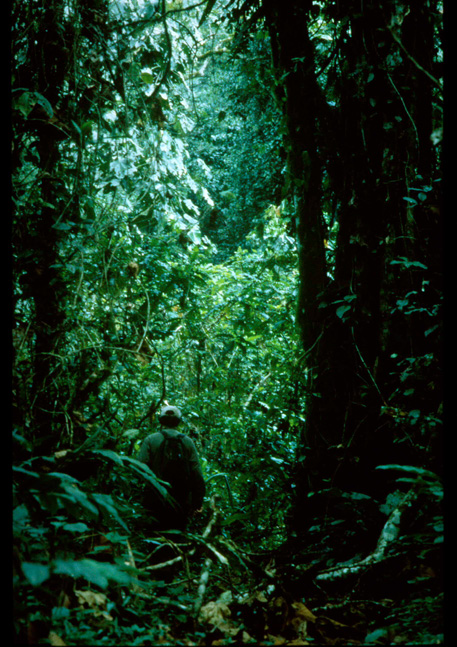
Working with these data brought back many vivid memories, such as the day I first saw chimpanzees in the wild, back in June 1996. I had come to Kibale to spend a summer doing pilot research. We hiked for hours in the forest to find the chimpanzees, following narrow trails up and down steep hills, stepping carefully along narrow logs lain across boggy patches in the valley bottoms. Everything looked green and wet. Towering rainforest trees hung with vines. Dense stands of wild ginger and other leafy tropical plants crowded the understory.

As we crept along a steep trail, an opening in the trees showed the misty green expanse of the valley below. At last, I caught my first fleeting glimpse of a chimpanzee – I think it was Stout, an adult male – as he crossed the trail. His long black hair glistened with rain as he knuckle-walked calmly but quickly through the forest, looking more like a gorilla than I had expected, having only seen chimpanzees in movies and zoos.

During my first weeks at Kanyawara, the chimps traveled in large parties with many males. I saw most members of the community, including old Lamy, with his crippled foot, new mothers Outamba and Tongo carrying their first infants, matriarch Lope and her family, including the gangly teenager Makoku and young Rosa, grey-bearded Stocky, tough young males Imoso and Johnny, and Big Brown, who was still the alpha male.

During my first few days in the field, the chimps hunted and killed a red colobus monkey, and had a brief, noisy, and (for me) completely confusing encounter with their neighbors, during which the stranger chimps came within sight of us, crashing through the underbrush, displaying at and running towards our chimps before running they turned and ran away. As it turns out, I had come just in time for the last weeks of Uvariopsis season.

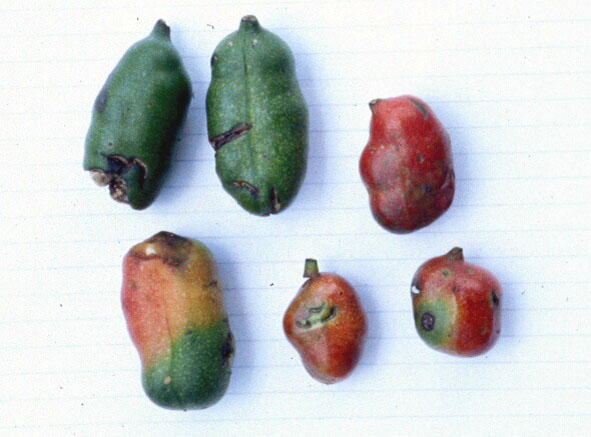
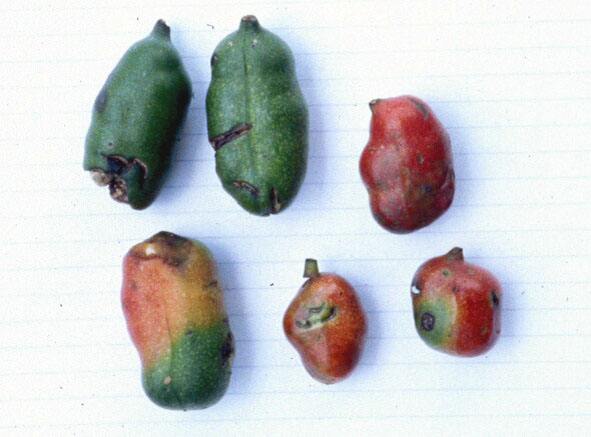
Uvariopsis congensis is a small tree that grows in large groves in the understory of the forest. It tends to fruit synchronously, usually in May and June. The fruits are small and red, and look rather like fleshy red peanuts, with two or three seeds.

At Kanyawara, the Uvariopsis groves occur mainly in the southeast of the range, along the border with another chimp community, which has not been habituated. And it turns out that that these Uvariopsis groves are a key focus of intergroup competition.

Back when I was doing my dissertation work, the number of intergroup encounters that had been observed at Kanyawara was still too small for meaningful statistical analysis. But now, in the 15-year dataset, we have records of 120 intergroup encounters. As is typical for chimpanzees, most of these encounters were shouting matches rather than full-fledged fights – chimpanzees gave loud pant-hoots and waa-barks and other calls, challenging their neighbors, and then ran either towards or away from them. But when chimpanzees came close enough to see each other, they were always hostile. Two chimpanzees were killed, and several others badly injured.  We found that these encounters happened mainly when chimpanzees visited border areas, especially the southern border.

So why did males visit border areas in the first place? To find mates, when few females in their own community were receptive? To find neighbors to attack, whenever they could gather in big enough parties to have a good chance of beating the neighbors? Or to look for food?

To answer these questions, we needed to use multivariate statistics to consider all these factors at once: mates, party composition, and food. We knew that male chimpanzees were highly motivated to search for mates, and we had previously found that parties that visited the range periphery had more males, presumably because that provided safety in numbers. But we also suspected that food would be an important part of the answer.

Chimpanzees spend most of their time searching for food, eating food, or digesting food. Though chimpanzees eat a variety of things, including monkeys, honey, ants, termites, leaves and stems, they spend most of their time eating ripe fruit from trees. In a tropical forest, the availability of tree fruits varies in a complex way over space and time. Some trees occur in groves in particular areas, whereas others are scattered about the forest. Some tree species, like figs, may produce food throughout the year, but other species fruit synchronously, with a big crop occurring every one or two years. To test how food influences chimpanzee movements, we needed data on both where and when key foods were located.

We had lots of data on feeding behavior. But it could be that chimpanzees travel to different parts of their range for social reasons (such as looking for mates or checking on the neighbors), and just happen to eat whatever they find along the way. So we needed to test whether the feeding data reflected where food was actually located. We therefore examined data from vegetation plots, and confirmed that both feeding data and vegetation plot data agreed that certain tree species were more common in the north, while others were more common in the south. For key species, we also found a good correlation between feeding behavior and independent measures of whether a sample of those trees had fruit in a given month. Additionally, the strong correlation between feeding records and counts of seeds from dung samples gave us confidence that our data on feeding behavior provided a good measure of what chimps were actually eating.

So what did we find?

Males tended to stay closer to the range center, and were less likely to travel to the south, when they were with more sexually receptive females. Party composition also mattered: as we had found previously, chimps were more likely to visit dangerous border areas when in parties with many males. And as we suspected, food had a big impact on chimpanzee movements. They visited the southern border mainly when southern fruits were in season. One species in particular had a strong effect on encounter rate: Uvariopsis. Most of the intergroup encounters took place in the southeast, in or near the Uvariopsis groves, and encounters were more likely to occur on days when chimps spent more time eating Uvariopsis.

So chimpanzees at Kanyawara visited borders for various reasons, but food seemed especially important. In particular, a good crop of Uvariopsis attracts chimps from both sides of the border, resulting in a spike in the rate of intergroup encounters during Uvariopsis season.

When encounters did occur, though, we found that the response depended mainly on the number of adult males that were present. Whether they were with mates, infants, or food didn’t matter as much as whether they had enough males to put up a good fight. These results were very much in line with what we had previously found with the playback experiments.

So is food generally the main driver of intergroup competition in chimpanzees? I’m currently working on data from Gombe to test whether similar factors apply there. It seems likely that in addition to food, the relative power of communities is a key factor. An interesting case in point is just 12 km from Kanyawara: the Ngogo community, studied by John Mitani and David Watts. This is the biggest chimpanzee community ever studied, with about 150 members. These chimps live in a range about the same size as Kanyawara’s, but in higher quality forest, with a lot more food, and three times the chimpanzees. And a lot more violence. The Ngogo chimps frequently patrol their boundaries, and in a ten-year period, Ngogo males killed 21 of their neighbors.

While the Ngogo chimps were killing their neighbors and expanding their range, the Kanyawara chimps were losing territory to their powerful southern neighbors (a group of unhabituated chimpanzees whose range appears to be sandwiched between Ngogo and Kanyawara). By 2006, the Kanyawara range was less than half as big as it had been in 1998, and the southern chimps had pushed the boundary a full kilometer north. It may be that chimps in a powerful community, like Ngogo, are more likely to go looking for trouble, whereas chimps in a weak community, like Kanyawara, visit dangerous border areas only when the abundance of food there makes the risk worthwhile.

Mom

After starting this blog in August, I hardly blogged at all during the semester. Partly this was because with my teaching and other duties, I had little time to spare for blogging. And in what spare time I did have, I wasn’t thinking about blog topics. I was thinking about my Mom, who was fighting what turned out to be a losing battle with leukemia.

Years ago, as the stem cells in Mom’s bone marrow were going about their usual business of dividing to make cells that would in turn give rise to new blood cells, one of them made a mistake. A deletion occurred on Chromosome 9. That cell divided and gave rise to a whole lineage of cells with the same deletion. Over time, some other cells in that lineage arose with additional genetic errors that prevented them from making proper blood cells. Instead, they produced millions and millions of daughter cells that filled up Mom’s marrow with useless cells, crowding out the good cells.

Mom only became aware that there was a problem a couple of years ago, when she was diagnosed with Myelodysplastic Syndrome (MDS), which often develops into leukemia. And in Mom’s case it did. In March, on her birthday, she was diagnosed with Acute Myeloid Leukemia (AML) and soon started her first round of chemotherapy.

Mom faced all of this with remarkable courage. In the hospital, she joked, made light conversation, took photos of all her visitors, and kept her good humor through all of the indignities of hospital life – the flimsy gowns, the lack of privacy, the constant parade of people coming into the room to do this or that, the increasing need for other people to help with basic bodily functions. Mom accepted all of this gracefully. Though she did not like revealing her birth year to other people, in the hospital many times a day she cheerfully gave her name and birthdate to hospital staff, as required when receiving new medications or blood transfusions. She always liked to look her best. When the chemo caused her hair to fall out, she wore wigs and hats – but mainly to make her visitors comfortable. Over Skype, she asked us if we wanted to see the bald head, and showed us when we said yes, seeming entirely cheerful and matter-of-fact about the loss of the hair that she had been so careful to keep just so over the years.

As a family, we tried to learn as much as we could about Mom’s condition and treatments. Dad bought and diligently read a medical textbook on hematology. This information was interesting enough, and helped us understand what Mom was going through, but we never found what we were looking for: some hidden nugget that would help Mom live. And the scientific literature was far from comforting. Studies of AML (such as here and here) found that for most patients, even with the best treatments available, life expectancy was a matter of months rather than years, especially if they were older, had a background of MDS, and had multiple detectable genetic changes in their chromosomes.

I’m not sure what I imagined chemotherapy would be like, but the actuality was both more peaceful and more awful than I had expected. For the most part, it involved just waiting in the hospital room, attached to a rack full of IV bags dripping an array of different fluids, including saline solution, blood, plasma, and chemotherapy drugs, into a PICC line – a tube inserted into the arm that directed the incoming fluids right to the heart. At first, it hardly seemed like Mom was really sick. She was just like she always was, except confined to a hospital room and attached to an IV drip. But gradually the chemo did its job and took its toll, and Mom got sicker and sicker.

One of the chemotherapy agents that Mom received was Cytarabine. This is chemically nearly identical to cytosine, one of the four bases that make up DNA. It is similar enough that it gets incorporated into new DNA, but different enough that that new DNA doesn’t work properly, and the new cells die as a result. So all the rapidly dividing tissues – cancer cells, but also hair, skin, and the intestinal lining – suffer as a result, resulting in all the usual chemotherapy side effects.

Another chemo drug Mom had was Daunorubicin – a ruby colored compound isolated in the 1950s from soil-living fungus in Italy and named for a pre-Roman tribe, the Dauni. The bright ruby color of this drug made it look especially potent and menacing when it was injected. Daunorubicin molecules are just the right shape to slip in between successive base pairs in DNA strands, unwinding the DNA a bit and interfering with replication. Again, this wreaks havoc, not just on cancer cells, but also on all healthy tissues that rely on rapid cell division.

Mom endured two rounds of chemo, achieved remission, and came home, where before long, life almost seemed back to normal. She cooked dinners, played bridge, went to church, and even traveled across the country to see her newest grandchild. It started to seem that Mom was healthy and out of danger.

However, while the chemo had killed a lot of cells, it hadn’t completely wiped out the mutant stem cells. Instead, the few surviving mutant cells continued to replicate, acquiring new mutations on the way. By September, the leukemia was back, and just before Thanksgiving, it took Mom away from us.

The chemo took a terrible toll, but without it, what happened in November would have happened in March. Thanks to the chemo, Mom had a summer at home, visits from her children and grandkids, and time to say goodbye.

Mom wanted to live, but during what turned out to be her final hospital stay, she talked of how the quality of life, and the prospects for improving it, diminish. In one of our last conversations, she told me, “I had hoped to live long enough to see how things turned out for everyone. But then, even if we lived to be over 100, we would still want more.”

Mom was one of the very best people I have ever known, and it seems terribly unfair that she should be taken from us so soon. It’s hard to believe that such a vibrant person, so full of love and caring and thoughtfulness, the keeper of so many family memories and traditions, should be undone by the information copying errors of the tiny, mindless cellular machinery of her own body.

Around the time Mom got sick, my computer crashed. The Genius at the Apple Store said it was a problem with the logic board, and that there was really nothing to be done, since the repairs would cost about as much as a new computer, and that in a computer of such advanced age (nearly five years old!), more problems would soon be arising. Luckily I had my data backed up, and almost all the files on my old computer are now on my new computer. But Mom is gone. There’s no backing her up.

Religious minded people will be tempted to provide reassurance that Mom is in Heaven. That’s certainly what Mom believed, and if such a place exists, then surely she is there. But my own inclination is to think that we are material beings, and that our lives begin and end on earth. This materialist view provides its own comforts. “No Hell below us – above us, only sky.” There is no one to blame for the loss of loved ones: it just happens. But whatever one believes about the metaphysical, Mom left behind a great big hole here on earth.